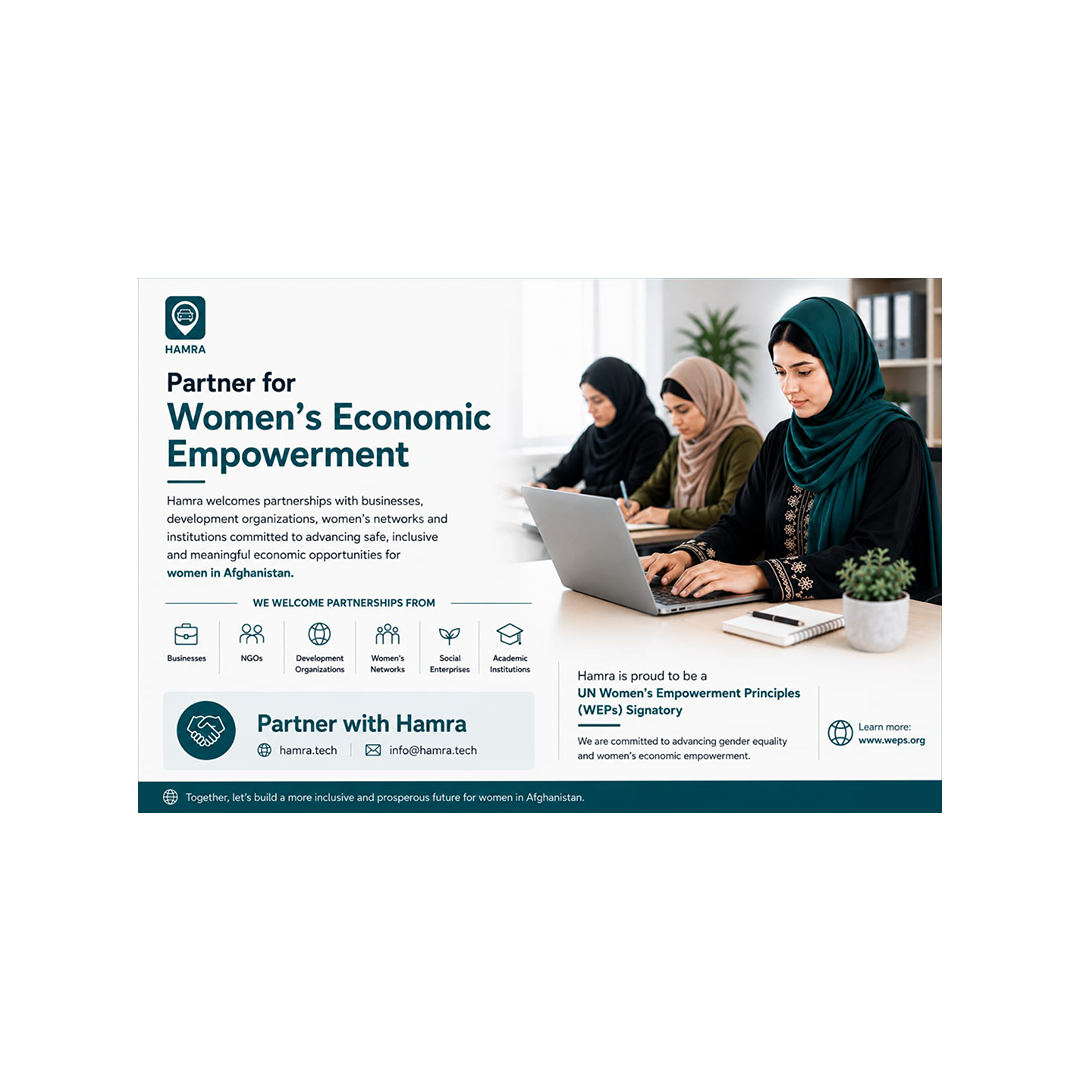
Hamra welcomes collaboration with businesses, development organizations, networks and other stakeholders committed to creating safe, inclusive and meaningful economic opportunities for women in Afghanistan.
An open invitation
We are looking for partners who treat women's economic participation as a design requirement — not as an afterthought, a quota or a communications exercise. If that describes your organization, this article explains the framework we work from and how a partnership with Hamra can start.
Why this invitation, and why now
Afghanistan's women face one of the most constrained economic environments in the world. Mobility, access to markets, access to finance and access to safe workplaces are all restricted at once, and those constraints reinforce each other. A training programme without a safe way to travel to it delivers little. A job offer without childcare, privacy and a credible grievance channel is rarely taken up. A market opportunity without access to payments and logistics never converts into income.
Because the barriers are interlocking, the responses have to be as well. That is why Hamra does not approach women's economic empowerment as a single product feature or a single project. We approach it as a system that has to be built with partners: employers who create the demand, development organizations who fund and de-risk the pathway, networks and associations who reach women where they already are, and technology that makes the whole thing safe, discreet and measurable.
What we mean by "safe, inclusive and meaningful"
These three words are used loosely in a lot of programming. We use them with specific meaning, and we expect partners to hold us to it.
Safe means that participation does not increase a woman's exposure to risk — physical, reputational, digital or financial. Safety covers the journey to work, the workplace itself, the data trail a woman leaves behind, and her ability to report a problem and be believed. Safety is assessed by the women involved, not asserted by the organization.
Inclusive means the opportunity is reachable by women who are not already advantaged: women outside Kabul, women with limited literacy or limited digital literacy, women with disabilities, widowed and female-headed households, and women who can only work under specific mobility or family constraints. If an opportunity is only accessible to a woman with a smartphone, a bank account and freedom of movement, it is not inclusive — it is selective.
Meaningful means the work is paid fairly and on time, is more than symbolic, offers progression, and builds a skill or an asset that survives the end of the project. A stipend that stops when a grant closes is a transfer, not an opportunity.
The framework we work from: the Women's Empowerment Principles
Rather than invent our own vocabulary, we anchor our commitments in an established international framework: the Women's Empowerment Principles (WEPs).
The WEPs are a set of principles offering guidance to business on how to advance gender equality and women's empowerment in the workplace, marketplace and community. They were established by UN Women and the UN Global Compact, are adapted from the Calvert Women's Principles®, and are informed by international labour and human rights standards. Subtitled Equality Means Business, they make the case that gender equality is both a rights obligation and a commercial one.
The WEPs are also a primary vehicle for corporate delivery on the gender equality dimensions of the 2030 Agenda and the UN Sustainable Development Goals. More than 3,000 business leaders worldwide have signalled that commitment by signing the CEO Statement of Support.
The seven Principles, and what each one means for a partnership in Afghanistan
| # | Principle | What we look for in practice |
|---|---|---|
| 1 | Establish high-level corporate leadership for gender equality | A named executive sponsor and a written commitment, not a CSR line item |
| 2 | Treat all women and men fairly at work; respect and support human rights and non-discrimination | Equal pay for equal work, transparent hiring, no discriminatory screening |
| 3 | Ensure the health, safety and well-being of all women and men workers | Safe transport, private facilities, anti-harassment policy with a real grievance channel |
| 4 | Promote education, training and professional development for women | Paid training time, entry-level pathways, mentoring and progression, not one-off workshops |
| 5 | Implement enterprise development, supply chain and marketing practices that empower women | Sourcing from women-owned businesses, prompt payment terms, non-stereotyped marketing |
| 6 | Promote equality through community initiatives and advocacy | Engaging families and community leaders so participation is socially sustainable |
| 7 | Measure and publicly report on progress to achieve gender equality | Baseline, disaggregated indicators and honest public reporting, including what did not work |
A useful first step for any partner
The WEPs offer a free, confidential self-assessment (the WEPs Gender Gap Analysis Tool) that lets a company see where it stands across the seven Principles before committing to anything. Partners who arrive with that baseline already in hand move much faster with us. Start at weps.org.
Three arenas, one commitment
The WEPs deliberately span three arenas, and a serious partnership usually touches all three.
- Workplace — who is hired, how they are paid, whether they are safe, and whether they can progress.
- Marketplace — who you buy from, who you sell to, how you contract, and how women appear in your marketing.
- Community — whether the environment around a woman's work supports or undermines her participation.
Programmes that work only in the workplace tend to stall, because the constraint is usually upstream in the community or downstream in the marketplace.
Who we want to work with
| Partner type | What collaboration typically looks like |
|---|---|
| Businesses and employers | Creating and filling roles that women can realistically take up and keep |
| Development organizations and donors | Co-designing and co-funding pathways, with independent verification of results |
| Networks, chambers and associations | Reaching women-owned enterprises and setting shared standards across members |
| Training providers and academic institutions | Building curricula tied to real, verified demand rather than to generic certificates |
| Women-led enterprises and cooperatives | Supplier relationships, distribution partnerships and market access |
| Technology and payment providers | Safety, identity and payment infrastructure that works under local constraints |
Six ways a partnership can start
- Employment and livelihoods pathways — designing roles, screening, onboarding and retention support so that a placement becomes a career rather than a statistic. (Principles 1, 2 and 4)
- Procurement and supply chain inclusion — committing a defined share of spend to women-owned suppliers, with payment terms that a small enterprise can actually survive. (Principle 5)
- Skills, training and mentorship — paid, demand-linked training with named employers attached to it before the first cohort starts. (Principle 4)
- Safety-by-design collaboration — co-developing the safeguards that make participation possible: verified identities, discreet profiles, trip and shift tracking, emergency escalation and reporting that leads to action. (Principle 3)
- Community engagement and advocacy — working with families, elders and local institutions so that a woman's participation is socially supported and therefore durable. (Principle 6)
- Measurement, research and public reporting — shared indicators, an agreed baseline, and publication of results including the parts that failed. (Principle 7)
Our non-negotiables
Do no harm comes first
A partnership that increases a woman's income while increasing her exposure to risk is not a success. We will decline or pause any collaboration that cannot meet the conditions below.
- Safeguarding. A written safeguarding policy, a confidential reporting channel, and a documented response process before any activity involving women participants begins.
- Consent and data protection. Personal data collected for a stated purpose only, stored securely, minimised by default, and never shared for publicity, donor storytelling or marketing without explicit, revocable and informed consent.
- Context sensitivity. Programme design that reflects the real mobility, privacy and family constraints women face — including the option of low-visibility participation where visibility would be dangerous.
- No tokenism. We do not participate in activities whose primary output is a photograph. If an activity cannot state what a participant will have — in income, skill or asset — six months later, we will say so.
- Local ownership. Afghan women shape the design, not only the delivery. Where a design decision affects participants, participants are consulted before it is made.
How we will measure it
Principle 7 is the one most often skipped, so we state it explicitly. A partnership with Hamra agrees on a baseline and a small set of indicators before launch, disaggregated by gender and, where relevant, by province and disability status.
| Dimension | Example indicators |
|---|---|
| Access | Number of women reached, share from outside major urban centres, share who are first-time participants |
| Quality of work | Median earnings, on-time payment rate, retention at 3, 6 and 12 months |
| Safety | Reported incidents, median time to resolution, share of participants who report feeling safe |
| Progression | Share moving to higher-responsibility or higher-paid roles, certifications completed |
| Enterprise | Number of women-owned suppliers engaged, share of procurement spend, average payment cycle |
We would rather publish a modest number that is true than an impressive number that is not.
How to start a conversation
Write to info@hamra.tech with the subject line "WEPs Partnership". To make the first exchange useful, please include:
- Who you are, where you operate in Afghanistan, and who at your organization is accountable for this work.
- Which of the seven Principles you are already acting on, and where you know you have gaps.
- What you are proposing: employment, procurement, training, safety design, community engagement or measurement.
- The constraints you are working under — funding cycle, geography, reporting obligations, risk appetite.
- Your safeguarding and data protection arrangements, or your plan to put them in place.
You can also reach us through our contact page, or apply directly through the partner application form. Our approach to user safety is described on the safety page, and our sustainability programme is on the Hamra Green page.
The standard we are holding ourselves to
Every Afghan woman who works with us or through us should end the engagement safer, more skilled and better paid than she started — and should be able to say so herself.
Learn more
- Women's Empowerment Principles — About
- CEO Statement of Support
- UN Global Compact — Women's Empowerment Principles
The Women's Empowerment Principles are established by UN Women and the UN Global Compact. Hamra references the Principles as the framework guiding its partnerships; this article does not imply endorsement of Hamra by either organization.